 In 2009, Art from Ashes founded the Running of the Gays event—a faux marathon in heels to fund creative empowerment workshops specifically for queer youth. Every year for 10 years, Art from Ashes has raised money from the LGBTQIA community and advocates through music, live shows featuring drag queens and kings, and spoken word poetry from LGBTQ+ youth and supporters, in order to show both emotional and practical support for the struggling young people in our community.
Because 2019 is the 50-year anniversary of the Stonewall riots, widely considered to be the single most important event leading to the gay liberation movement and the modern fight for LGBT rights in the United States, Art from Ashes Communications Team Lead Abigail Fanara has written the article below that highlights the history of that movement and the inception of the first gay pride parades in the United States and many other countries.
50 Years Ago
In 1969, there were only a few places in the United States where LGBTQIA people could just “be”—the places your parents warned you about and that society condemned. One such place was the Stonewall Inn in Greenwich Village, New York, now a designated U.S. National Historic Landmark and National Monument. At that time, Stonewall was owned by the mob, which took advantage of the liquor laws in New York that discriminated against anyone who was even suspected of being gay. They served watered down alcohol in unsanitary conditions without a liquor license, which was fine as long as they paid off the police. But that dirty, unlicensed dive bar was a sacred place for LGBTQIA people. It was a place where drag queens, gays, lesbians, and “street kids,” (many of whom were sex workers living on the streets, shunned by their families) were free to be themselves.
By 1969 the LGBTQIA movement was still small, but growing, and those who were a part of it were in constant danger of attack or arrest. Being “out” was not an option if you wanted to have a job, housing, or simply not be arrested or admitted to a mental health facility. Homosexuality was criminalized and treated as perversion or psychopathy. Police, particularly the NYPD, often used entrapment and raids as a way to arrest LGBTQIA people for occupying a public space.
1969 was a mayoral election year in New York City, and John Lindsay, up for reelection, pledged to “clean up” the Village that summer. The existing targets on the backs of LGBTQIA residents in the Village grew larger, and safety became more elusive. The raids and police harassment became more and more frequent. On June 28th of that year, for the second time that week, the police raided the Stonewall Inn. What happened during that raid changed the lives of LGBTQIA Americans forever.
Maybe it was the particularly violent treatment of a lesbian woman fighting her arrest, and equally as likely, enough was just enough, but the raid at the Stonewall Inn that night did not go according to plan. A large crowd gathered as the police were demanding I.D.s and loading drag queens into paddy wagons. At first, the crowd talked back and made fun of the police. Then the crowd began to grow, and according to witnesses, a sense of rage began to take over. The rage was about the harassment and violence committed by the police, about the box that society had forced them to live in, and the discrimination they faced every day over who they were born to be. Eventually, that rage turned into action for gay liberation.
Fires were started. Trash cans, bricks, and bottles were thrown at the police who, not expecting any trouble, were so scared they barricaded themselves inside the bar. The crowd outside grew larger and angrier. Finally, buses full of backup police showed up in full riot gear. They started pushing the crowd away from Stonewall, but the crowd would just re-form in an alley or side street and come back right behind the police. This went on for hours.
Protests continued for days and got increasingly more risky and violent, but the LGBTQIA movement had gained momentum, and they were determined to make it count. The Gay Liberation Front was formed. Sylvia Rivera and Marsha “Pay It No Mind” Johnson, two gender nonconforming drag queens and sex workers who were at Stonewall on June 28th formed S.T.A.R (Street Transvestite Action Revolutionaries). S.T.A.R. was a leftist, gender nonconforming organization that served homeless LGBTQIA youth and sex workers by providing housing and other forms of support. The LGBTQIA movement was becoming larger and more organized. One year later, the Christopher Street Liberation Day parade marked the anniversary of the Stonewall Uprising and was the first major LGBTQIA Pride march in the United States.
Those the Movement Left Behind
Though the Stonewall Uprising gave the LGBTQIA movement a giant push into the mainstream, there were groups that were largely left behind. Some feminist lesbians in the movement felt that gender nonconforming drag queens were being misogynistic when they dressed in women’s clothes. Because of this, at the 1973 Gay Pride parade, people like Rivera and Johnson were asked to march at the back of the parade. These were the queens of the Stonewall Uprising, however, so they did not comply. Sylvia Rivera marched on stage and called the movement out for their mistreatment of women of color and the gender nonconforming drag queens who had risked and lost so much for the movement. She spoke of the work that S.T.A.R did with, “your gay brothers and your gay sisters in jail, who write to me every motherfuckin’ week and ask me for your help.” Rivera, nearly out of breath, yelled out her personal sacrifice that led to the existence of that very march: “I have been beaten. I have had my nose broken. I have been thrown in jail. I have lost my job. I have lost my apartment for gay liberation and you all treat me this way?” She ended her speech leading an emotional chant for “gay power.”
Most of the patrons of Stonewall were “street kids,” sex workers, and drag queens, and they often were on the front lines in the daily battle for gay liberation. They were harassed, murdered, beaten, taken to jail at higher rates than anyone else within the movement. In the case of gay rights (and arguably, in many cases in many movements), the ones with the least, gave the most. In 1973, S.T.A.R was dissolved.
In 1999, Johnson’s body was found in the Hudson River under suspicious circumstances. The police deemed it a suicide and closed the case without further investigation, although many of her friends suspected foul play. Some witnesses even told the police they saw her running from someone the evening she died. Horrifically, Johnson’s death is not unlike many within the trans community. For years, trans women (particularly trans women of color) were being murdered with no response from the police, the media, or the mainstream LGBTQIA community.
In 2000, eight days before the anniversary of the Stonewall Uprising, a 25-year-old trans woman of color named Amanda Milan was murdered at a bus terminal in New York City by a man who had been harassing her. She was stabbed in the neck and died at St. Vincent’s hospital that night. Milan’s case garnered attention and outrage from the trans community. Rivera reformed S.T.A.R (Street Trans Action Revolutionaries) in response to Milan’s murder and worked to ensure her case was investigated and called for a broadening of the definition of gender to the New York City Human Rights Law. For the first time, people were paying attention to the murder of a trans woman, yet her murderer was still only sentenced to 17 years in prison.
LGBTQIA Today
While many battles in the fight for gay liberation have been won, there is still so much work to be done. Today, trans women of color are murdered at staggering rates and face more violence than anyone else in the LGBTQIA community. Murders of trans women of color still largely get brushed under the rug, and if there is a conviction, the jail time is like a slap on the wrist. While more youth feel they can openly identify as gay, lesbian, transgender, or queer, rates of violence and harassment are still high. LGBTQIA youth face higher rates of addiction, homelessness, and suicide than their non-LGBTQIA peers.
In spite of the forces against the LGBTQIA community, the movement is growing bigger and getting stronger. Whenever you start to shine brighter, the darkness will try harder to overtake you. But just as the queens of Stonewall fought back and changed the course of the gay rights movement in one significant evening, so can we. Most of the people at the Stonewall Uprising were young, some still in their teens.
50 years ago, on June 28th, 1969, a group of young outcasts changed the country for the better. They are the reason we celebrate Pride every year. They didn’t have much, and at the time, they didn’t even have a unified community, yet they still managed to make a serious impact and put LGBTQIA into the mainstream.
Progress ebbs and flows and there will always be work to be done. So celebrate this month, celebrate the progress that’s been won, the people who won it, and the people who fight still. Celebrate yourself, have pride in who you are and everything that makes you you.
As we all continue the fight for liberation, let’s remember the work and sacrifice that it took. Remember Marsha “Pay It No Mind” Johnson and Sylvia Rivera, remember Matthew Shepard and Amanda Milan and all those who have left us too early, and so tragically. Remember what we all are fighting for, remember to be inclusive. Most importantly, remember that none of us are alone; that there are many of us who stand together—that there are communities like Art from Ashes that exist to hold space for those who don’t believe they belong. ❤️

3-Ways
/in Blog, News/by AfAAdminHoliday Greetings!
It’s so fitting that our Colorado winter aligns with the season of light and giving! Sure, it’s a little bit colder, it’s a little bit darker, and we all could use a little warmth (and cookies). But what better way to nourish your spirit than investing in an organization that facilitates positive transformation through creative expression and empowerment? Giving to Art from Ashes is a great way to be part of this beautiful process of transformation through poetry, art and self expression. Whether it be through a financial contribution, those aforementioned cookies, or sharing in some laughs and celebration with us (come to our party!), we’d love to hear from you this season.
We made this awesome postcard to update you about some really easy ways to give to AfA right now. We also want to make sure you knew that at 7pm on Dec 10th, Colorado Gives Day, we’re having a Celebration of Light and we’d love to see you there! Come ready to have the kind of time that leaves you smiling for days and makes your heart beat a little stronger.
If you shop online, you can help out the cause:
We encourage you to support local small businesses when buying gifts. But if you do shop Amazon, please use Smile.Amazon.com and select Art from Ashes incorporated from the list of nonprofits! It would be amazing if you also wanted to shop for items on our Wish List.
All Sacred Foundation 2019
/in Blog, Events, News/by AfAAdminOn August 2, long-time advocates and tattoo artists at All Sacred Tattoo Foundation invited Art from Ashes staff, volunteers, and youth poets to their new shop in Wheat Ridge for the “Behind the Veil” art show and fundraising event.
Committed to community betterment, All Sacred Foundation artists “tattoo with heart.” All Sacred’s well-known and sought after artists provided tattoos to the public at these events and donated all proceeds to three area nonprofits, including Art from Ashes!
Four Art from Ashes youth poets performed in front of a crowd of supporters who applauded the courage of their voices. Hear AfA’s Founder and Executive Director Catherine O’Neill Thorn’s spirited speech below! (And check out her new tattoo in the slideshow!)
We are grateful for the continued love and support from Aries Rhysing, All Sacred Tattoo Foundation, and all those who donated to Art from Ashes at the Behind the Veil event. Congratulations on your beautiful new shop!
[slideshow_deploy id=’8205′]
Video of Catherine’s speech: 08-2019 All Sacred-Catherine-smaller
Did you miss the event, but still want to support Art from Ashes and get some cool All Sacred art? Check out their merchandise store! One third of all proceeds go directly to Art from Ashes and our award winning programming: https://allsacred.com/shop/
Writing Prompt-Defying Gravity
/in Blog, Creativity, Poems, Writing Prompts/by AfAAdminSet a timer for three minutes and write without thinking or editing until the time is up! Here’s a prompt to help you get started…
World Denver Youth Workshops
/in Blog, Creativity, News/by AfAAdminEach year World Denver partners with Art from Ashes to present our program to dignitaries around the world, including the Philippines, Great Britain, Malaysia and other nations. We also are privileged to provide workshops for the Iraqi Youth Delegation.
The Iraqi Young Leaders Exchange Program (IYLEP) for high school students and adult mentors is a program sponsored and funded by the U.S. Embassy, Baghdad and U.S. Department of State, Bureau of Educational and Cultural Affairs, Youth Programs Division. Through IYLEP, participants can develop skills in leadership and civic engagement through workshops as well as build mutual understanding between the people of Iraq and the U.S. through homestays.
My Voice Is
By Tava
My voice is stuck
Between the real self
And the person I want to be
Who is the person I want to be?
It’s the person people want to see
A person that keeps quiet
A person that society wants
A person who ‘behaves’
Could the self be defined
Without society’s standards?
Is there such a thing
As the self?
With the personalities
And looks
That society has taught us?
If I grew in the mountains, the trees,
Next to the water
Would I have been louder?
[slideshow_deploy id=’8178′]
50th Anniversary of Stonewall
/in Blog, News/by AfAAdminBecause 2019 is the 50-year anniversary of the Stonewall riots, widely considered to be the single most important event leading to the gay liberation movement and the modern fight for LGBT rights in the United States, Art from Ashes Communications Team Lead Abigail Fanara has written the article below that highlights the history of that movement and the inception of the first gay pride parades in the United States and many other countries.
50 Years Ago
In 1969, there were only a few places in the United States where LGBTQIA people could just “be”—the places your parents warned you about and that society condemned. One such place was the Stonewall Inn in Greenwich Village, New York, now a designated U.S. National Historic Landmark and National Monument. At that time, Stonewall was owned by the mob, which took advantage of the liquor laws in New York that discriminated against anyone who was even suspected of being gay. They served watered down alcohol in unsanitary conditions without a liquor license, which was fine as long as they paid off the police. But that dirty, unlicensed dive bar was a sacred place for LGBTQIA people. It was a place where drag queens, gays, lesbians, and “street kids,” (many of whom were sex workers living on the streets, shunned by their families) were free to be themselves.
By 1969 the LGBTQIA movement was still small, but growing, and those who were a part of it were in constant danger of attack or arrest. Being “out” was not an option if you wanted to have a job, housing, or simply not be arrested or admitted to a mental health facility. Homosexuality was criminalized and treated as perversion or psychopathy. Police, particularly the NYPD, often used entrapment and raids as a way to arrest LGBTQIA people for occupying a public space.
1969 was a mayoral election year in New York City, and John Lindsay, up for reelection, pledged to “clean up” the Village that summer. The existing targets on the backs of LGBTQIA residents in the Village grew larger, and safety became more elusive. The raids and police harassment became more and more frequent. On June 28th of that year, for the second time that week, the police raided the Stonewall Inn. What happened during that raid changed the lives of LGBTQIA Americans forever.
Maybe it was the particularly violent treatment of a lesbian woman fighting her arrest, and equally as likely, enough was just enough, but the raid at the Stonewall Inn that night did not go according to plan. A large crowd gathered as the police were demanding I.D.s and loading drag queens into paddy wagons. At first, the crowd talked back and made fun of the police. Then the crowd began to grow, and according to witnesses, a sense of rage began to take over. The rage was about the harassment and violence committed by the police, about the box that society had forced them to live in, and the discrimination they faced every day over who they were born to be. Eventually, that rage turned into action for gay liberation.
Fires were started. Trash cans, bricks, and bottles were thrown at the police who, not expecting any trouble, were so scared they barricaded themselves inside the bar. The crowd outside grew larger and angrier. Finally, buses full of backup police showed up in full riot gear. They started pushing the crowd away from Stonewall, but the crowd would just re-form in an alley or side street and come back right behind the police. This went on for hours.
Protests continued for days and got increasingly more risky and violent, but the LGBTQIA movement had gained momentum, and they were determined to make it count. The Gay Liberation Front was formed. Sylvia Rivera and Marsha “Pay It No Mind” Johnson, two gender nonconforming drag queens and sex workers who were at Stonewall on June 28th formed S.T.A.R (Street Transvestite Action Revolutionaries). S.T.A.R. was a leftist, gender nonconforming organization that served homeless LGBTQIA youth and sex workers by providing housing and other forms of support. The LGBTQIA movement was becoming larger and more organized. One year later, the Christopher Street Liberation Day parade marked the anniversary of the Stonewall Uprising and was the first major LGBTQIA Pride march in the United States.
Those the Movement Left Behind
Though the Stonewall Uprising gave the LGBTQIA movement a giant push into the mainstream, there were groups that were largely left behind. Some feminist lesbians in the movement felt that gender nonconforming drag queens were being misogynistic when they dressed in women’s clothes. Because of this, at the 1973 Gay Pride parade, people like Rivera and Johnson were asked to march at the back of the parade. These were the queens of the Stonewall Uprising, however, so they did not comply. Sylvia Rivera marched on stage and called the movement out for their mistreatment of women of color and the gender nonconforming drag queens who had risked and lost so much for the movement. She spoke of the work that S.T.A.R did with, “your gay brothers and your gay sisters in jail, who write to me every motherfuckin’ week and ask me for your help.” Rivera, nearly out of breath, yelled out her personal sacrifice that led to the existence of that very march: “I have been beaten. I have had my nose broken. I have been thrown in jail. I have lost my job. I have lost my apartment for gay liberation and you all treat me this way?” She ended her speech leading an emotional chant for “gay power.”
Most of the patrons of Stonewall were “street kids,” sex workers, and drag queens, and they often were on the front lines in the daily battle for gay liberation. They were harassed, murdered, beaten, taken to jail at higher rates than anyone else within the movement. In the case of gay rights (and arguably, in many cases in many movements), the ones with the least, gave the most. In 1973, S.T.A.R was dissolved.
In 1999, Johnson’s body was found in the Hudson River under suspicious circumstances. The police deemed it a suicide and closed the case without further investigation, although many of her friends suspected foul play. Some witnesses even told the police they saw her running from someone the evening she died. Horrifically, Johnson’s death is not unlike many within the trans community. For years, trans women (particularly trans women of color) were being murdered with no response from the police, the media, or the mainstream LGBTQIA community.
In 2000, eight days before the anniversary of the Stonewall Uprising, a 25-year-old trans woman of color named Amanda Milan was murdered at a bus terminal in New York City by a man who had been harassing her. She was stabbed in the neck and died at St. Vincent’s hospital that night. Milan’s case garnered attention and outrage from the trans community. Rivera reformed S.T.A.R (Street Trans Action Revolutionaries) in response to Milan’s murder and worked to ensure her case was investigated and called for a broadening of the definition of gender to the New York City Human Rights Law. For the first time, people were paying attention to the murder of a trans woman, yet her murderer was still only sentenced to 17 years in prison.
LGBTQIA Today
While many battles in the fight for gay liberation have been won, there is still so much work to be done. Today, trans women of color are murdered at staggering rates and face more violence than anyone else in the LGBTQIA community. Murders of trans women of color still largely get brushed under the rug, and if there is a conviction, the jail time is like a slap on the wrist. While more youth feel they can openly identify as gay, lesbian, transgender, or queer, rates of violence and harassment are still high. LGBTQIA youth face higher rates of addiction, homelessness, and suicide than their non-LGBTQIA peers.
In spite of the forces against the LGBTQIA community, the movement is growing bigger and getting stronger. Whenever you start to shine brighter, the darkness will try harder to overtake you. But just as the queens of Stonewall fought back and changed the course of the gay rights movement in one significant evening, so can we. Most of the people at the Stonewall Uprising were young, some still in their teens.
50 years ago, on June 28th, 1969, a group of young outcasts changed the country for the better. They are the reason we celebrate Pride every year. They didn’t have much, and at the time, they didn’t even have a unified community, yet they still managed to make a serious impact and put LGBTQIA into the mainstream.
Progress ebbs and flows and there will always be work to be done. So celebrate this month, celebrate the progress that’s been won, the people who won it, and the people who fight still. Celebrate yourself, have pride in who you are and everything that makes you you.
As we all continue the fight for liberation, let’s remember the work and sacrifice that it took. Remember Marsha “Pay It No Mind” Johnson and Sylvia Rivera, remember Matthew Shepard and Amanda Milan and all those who have left us too early, and so tragically. Remember what we all are fighting for, remember to be inclusive. Most importantly, remember that none of us are alone; that there are many of us who stand together—that there are communities like Art from Ashes that exist to hold space for those who don’t believe they belong. ❤️
Running of the Gays 2019
/in Events, Public Events, Running of the Gays/by AfAAdminCome out and join Denver’s LGBTQIA community and Allies as we run toward a better future for youth at the 10TH ANNUAL Running of the Gays!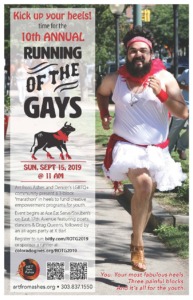
Get yer heels (and ankles!) ready to roll… or strut, or hop, or stumble in a 3-block “marathon” in heels to fund creative empowerment programs for queer youth in the Denver community. The event is organized by Art from Ashes, Denver’s LGBTQIA* community and Allies. Each year runners are asked to raise money through sponsorships to trot 3 blocks down 17th Avenue in heels, starting at Ace Eat Serve patio next to Steuben’s Food Service followed by an all ages (until 1.30 pm) after party at X Bar!
Proceeds contribute to continuing transformational creative programs for local youth who identify as LGBTQ+. While the event is silly, the statistics for our LGBTQ+ young people are decidedly unfunny: gay and lesbian youth are two to three times more likely to commit suicide than other youths, and 30% of all completed youth suicides are related to the issue of sexual identity; 45% of gay males and 20% of lesbians surveyed reported having experienced verbal harassment and/or physical violence during high school as a result of their sexual orientation; 26% of gays and lesbian youth are forced to leave home because of conflicts with their families over sexual identity. Art from Ashes provides creative programs with proven results that improve self-perception and increase involvement with and connection to the community.
Run a 3-block marathon in heels to help fund creative empowerment workshops for the queer youth in our community! You’ll be able to register with a $35 donation ($40 after Aug 15th).
REGISTER TO RUN HERE!: bit.ly/ROTG2019
The fee entitles runners to the ROTG “I brought the gay” t-shirt, a goodie bag, a free Mimosa courtesy of Steuben’s, and a foot massage!
Runners are asked to seek sponsorships from friends and family to raise money for the youth programs.
SPONSORS WILL BE ABLE TO SUPPORT SPECIFIC RUNNERS BY DONATING THROUGH FACEBOOK, PAYPAL, GIVINGFIRST, OR WITH A CHECK.
Donate through ColoradoGives: www.coloradogives.org/ROTG2019
Donate through Paypal GIving Fund (100% goes to AfA!): bit.ly/PayPal-AfA
If you are sponsoring a specific runner, please enter their name in the Special Instructions field or by writing their name on your check. Please send checks to 1310 West 10th Ave, Denver CO 80204.
BUSINESS PARTNERS CAN SUPPORT THE MARATHON BY CONTACTING US USING THE FORM BELOW OR BY CALLING 303.837.1550!
So many thanks to our wonderful annual business sponsors. Some have been sponsoring Running of the Gays since 2010! If you’re interested in supporting our youth programs, please download our ROTG Sponsor Menu for levels of sponsorship and associated benefits. We love to support community businesses that support creative empowerment programs for queer youth!
Runners gather at the bullpen at Ace Eat Serve/Steuben’s at 11 am to sign in, stretch and enjoy the street show. After Party, foot massages, drag show and silent auction will be held at X Bar from noon to 1.30 pm!
See on our ROTG Facebook page to see the photos from previous years, as well as find out more information.
Thank you to our business sponsors who make the whole thing possible!
Out Front Magazine :: Payroll Vault :: The Bank of Denver :: Queen City Collective Coffee
Thank you to all those who have “come out” in the past. Re-live the fun here:
[slideshow_deploy id=’4067′]
Colorado Creative Industries Award 2019-20
/in Award, Blog, News/by AfAAdminArt from Ashes is honored to again be recognized as one of the top nonprofits working in the arts in Colorado by Colorado Creative Industries.
It’s Like Making the Boat Rock
/in Blog, Creativity, Poems/by AfAAdminInterview with 19-year-old youth poet Zaya Heffenger: “It’s definitely one of the deeper connections I’ve ever had”…
Getting through the Bullshit: An Interview with Allison Parks
/in Blog, News/by AfAAdminby Anna Ingraham
When I was asked to interview Allison Parks, an Art from Ashes donor, I didn’t realize that I had already met Allison. I volunteered at the Art from Ashes annual Celebration of Light in December, where I had the honor of witnessing not only the incredible performances by youth, but also a large, surprise donation from a lovely woman and her real estate company. I was standing in the back as Allison gave Catherine her generous gift, but even from my corner, I felt that the magic wasn’t only coming from the warm lighting.
Of course, Catherine brought Allison to the microphone to say a few words, and I remember the passion in her voice for supporting the work that Art from Ashes does to empower youth. I also remember the joy and love on Catherine’s face as she listened, and the general feeling of goodwill that permeated the room. It was indeed a Celebration of Light.
Allison Parks owns a real estate brokerage called Conscious Real Estate. They run on a donation model, which means that when anyone buys or sells a home, her company donates ten percent of the commission to a nonprofit of their client’s choice. Sometimes the clients don’t know which nonprofit to choose, so they leave it up to Allison. While talking with Allison on the phone, I was lucky enough to learn more about why someone who could donate to any of the various nonprofits in Denver feels so strongly about supporting Art from Ashes.
Featured donor, Allison Parks, with AfA Executive Director Catherine O’Neill Thorn
Allison met Catherine three or four years ago when she was taking time to go around Denver meeting nonprofit directors to tell them about her company. She had an evening appointment with Catherine, and she laughingly told me that she wasn’t looking forward to another meeting after a long day of work. She didn’t know what she was walking into, for as soon as she arrived at the Art from Ashes space, Catherine invited her to join a poetry workshop full of teenagers already in session. She remembers thinking, who are these kids? But as she began to participate, Allison was blown away by what the teens wrote and were willing to share. Being in the workshop had a huge impact on Allison, causing her to immediately fall in love with Art from Ashes and with Catherine. Since then, she’s enjoyed making surprise donations whenever she’s able, including this past December.
Allison joined the board for Art from Ashes, but soon decided she could have a bigger impact on the organization by donating through her real estate business. When I asked why she continues to donate and support AfA, Allison said, “Catherine got me. There are so many good nonprofits, but she just got me somehow.”
She spoke about how many organizations she’s visited to discuss donating, and how she appreciates “the authenticity of not having to sit around and read somebody’s stupid report that’s written on card-stock.” She continued by saying, “I don’t care what’s on the paper. Give me a story of what happened in someone’s life. It’s partly Catherine and partly just the kids. It hit me again during the Christmas party. I’m so damn proud of those young people. What they do is just mind-blowing, and Art from Ashes gives them the vehicle to do that. I have friends who participated in AfA when they were teens, and it was huge in their lives. It was a turning point for them.”
About her own experiences as a teenager, Allison told me that she grew up in rural Illinois, where there were not many resources or programs available for exploring writing. She wrote a little, but didn’t have the venue to explore her voice like the AfA participants. She talked about her experience in one of the six-week adult writing workshops AfA offers. She easily remembered one of the first exercises they were asked to do in the program, where they were instructed to write a three-minute poem from the prompt “Love is.” When the participants read their poems out loud, they were told to change it to “I am.” Allison said, “So many people start crying when they read those words and acknowledged that they are those beautiful things. To be able to stop and witness that for a minute brings on tears for everybody. It’s a good message of reconnecting with our core essence and remembering who we are.” She added to this idea of cutting through the surface to get to our inner core, calling it, “getting through the bullshit.”
It seemed that the biggest take-away Allison got from the adult workshop was the importance of self-love, a message that also comes through in the workshops that AfA offers to struggling youth. Allison said, “Our culture does not teach self-love. So much of consumerism is based on getting us not to love ourselves as we are. It’s important to start taking those steps toward loving yourself and realizing who you really are, that you are enough, and that you belong here. Sharing the poetry and the work you do is about embodying that voice, solidifying that self-love. Having other people be your mirror helps the roots grow.” Her final comment about the adult workshop was that “it makes you absolutely realize that this model and curriculum is pretty potent.”
When I asked Allison how she sees herself continuing to work with Art from Ashes, she said that she sometimes fantasizes about facilitating youth workshops. For now though, she’s making time to care for herself and is thinking about taking up singing and dancing. She said, “I have a feeling that once I dive in, I might find something there. Sometimes when we indulge in that creativity, it helps uncover something,” a statement with which, I feel, all of us at Art from Ashes would agree.
Allison’s sense of humor and depth of thought came across loud and clear. She will continue to donate to AfA and I could tell even from our brief conversation how much she cares about giving youth the space and resources to express themselves and connect with their creative genius. Art from Ashes is honored to have the support of such a creative, honest, and generous woman. It’s individuals like Allison and moments like the holiday party that keep our spirits strong and fuel us to continue bringing empowering workshops to the youth we serve.